BUILD-TO-ORDER & MASS CUSTOMIZATION
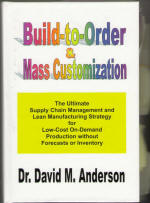
"Build-to-Order & Mass Customization; the Ultimate Supply Chain Management and Lean Manufacturing Strategy
for Low-Cost On-Demand Production without Forecasts or Inventory," by Dr. David M.
Anderson, (2004, CIM Press), Hardbound, 520 pages, ISBN
1-878072-30-7; $49.95. Leading-edge
methodologies correspond to Dr. Anderson’s
consulting
and seminars.
See the complete Table of Contents below.
To order the book, go to
Amazon.com . List price is $49.95.
Description: This new book challenges many conventional
practices and shows how to implement a revolutionary business model with evolutionary
self-supporting steps. Instead of managing complex supply chains, the
book has five chapters to show how to simplify supply chains to the point
where parts can be spontaneously resupplied without forecasts or purchase
orders. Instead of wrestling with all the problems of inventory, "on-demand
lean production" can build products spontaneously without any
finished-goods inventory. This and several other cost reduction strategies allow
significant reductions in total cost. The same production facilities can
build-to-order a wide variety of standard products and mass-customize
products for niche markets or individual customers.
The book is written for both managers and implementers with a
64 page executive overview of the whole book followed by 400 pages of detailed
methodologies and implementation strategies. There are 300 sidebars throughout
the book that emphasize key points.
Many product scenarios has been worked out for several industries and will be
published in the subsequent "Build-to-Order & Mass Customization
Casebook." These specific methodologies are available now for
consulting
and seminars clients.
See Table of Contents below for
"Build-to-Order & Mass Customization."
DESIGN FOR MANUFACTURABILITY
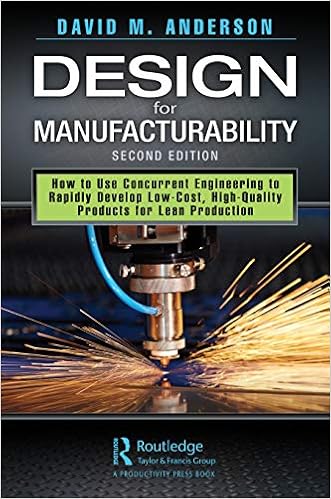
"Design for Manufacturability & Concurrent Engineering; How to:
Design for Low Cost, Design for High Quality, Design for Lean Production, and
Design Quickly for Fast Production" by Dr. David M. Anderson, (2008, 448 pages, CIM
Press). This new book covers all the topics needed to
show the reader how to design products for manufacturability, lean production, assembly,
flexibility, time-to-market, quality, and reliability. It also shows how to
implement DFM company-wide with the latest material on Concurrent Engineering,
QFD, architecture optimization, standardization, and shortening product
development time and cost. The book has over 200 DFM guidelines that can be used immediately by designers or
adapted and issued to engineers as part of a DFM program. The new revised second
edition has grown 40% to 312 pages with 20 illustrations, 125 references, and a
14 page index. Priced at $49.95; quantity discounts are available.
See Table of Contents
below. Complete index
is on line at www.design4manufacturability.com.
To order the book click here to go to
Amazon.com
For a summary about DFM seminars on this site, click
here. For
more information on DFM, see http://www.design4manufacturability.com
HALF COST PRODUCTS
"Half Cost Products: How to Develop, Build, and Deliver Products at Half
the Total Cost," is being written by David M. Anderson. These ultimate cost-reduction strategies are available now through Dr.
Anderson’s seminars and
consulting.
Many articles and a comprehensive eight-part cost reduction strategy can
be found at
www.HalfCostProducts.com .
AGILE PRODUCT DEVELOPMENT FOR MASS CUSTOMIZATION
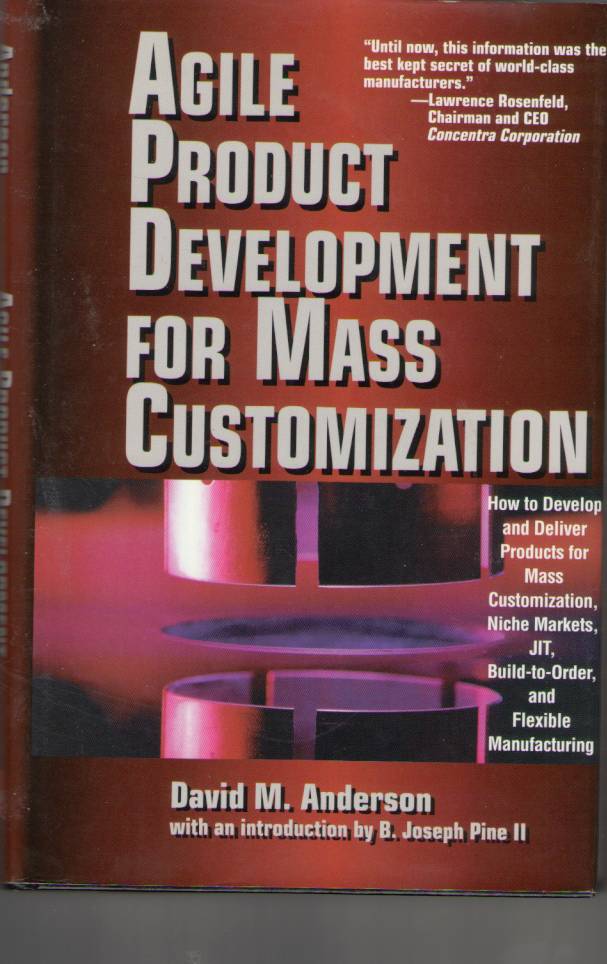
"Agile Product Development for Mass Customization; How to Develop and
Deliver Products for Mass Customization, Niche Markets, JIT, Build-to-Order, and
Flexible Manufacturing," by David M. Anderson, with an introduction by
B. Joseph Pine II, published by McGraw-Hill in 1997 is now out of print. The book
has been printed in a Chinese
translation (simplified character Mandarin) from McGraw-Hill's Singapore office:
www.asia-mcgraw-hill.com.sg
Links to mass customization seminars
and consulting.
Link to book description and used book order links at www.amazon.com
=================================================================
Table of Contents, Build-to-Order & Mass
Customization
PART I: OVERVIEW
PREFACE
INTRODUCTION 1
Current Attempts at Build-to-Order 2
Searching for Inventory 2
Capital Equipment Built "To Order" 2
BTO from Forecasted Parts Inventory 4
Precedents 4
Dell Computer 5
Strategy For BTO&MC 7
1. EXECUTIVE OVERVIEW 11
Shortcomings of Mass Production, Summary 13
Supply Chain Simplification, Summary 13
Product Line Rationalization, Summary 14
Part Standardization, Summary 16
Raw Material Variety Reduction, Summary 19
Outsourcing vs. Integration, Summary 21
Spontaneous Supply Chain, Summary 28
On-Demand Lean Production, Summary 37
Mass Customization, Summary 44
Concurrent Design of Products and Processes, Summary 49
Minimizing Total Cost, Summary 54
Measuring Total Cost, Summary 58
Implementing BTO&MC,
Summary 61
The Business Case for BTO&MC,
Summary 69
2. THE SHORTCOMINGS OF MASS PRODUCTION 75
1923 – The Heyday of Mass Production 75
If You Build It, They Might Come 75
Forecasting – A High Stakes Gamble 77
Defects by The Batch 79
Its Only Overhead 79
Take All Orders 80
The Effect of Variety on Mass Production 81
The Cost of Variety 82
Trying to Make Mass Production Flexible 85
Time For New Paradigms 86
Part II: SUPPLY CHAIN SIMPLIFICATION
3. PRODUCT LINE RATIONALIZATION 89
Pareto’s Law for Product Lines 90
Focus 90
How Rationalization Can Triple Profits! 91
Cost Savings From Rationalization 94
Short Term Cash Savings: 94
Investments: 95
Shifting Focus to The Most Profitable Products 96
What Is The Goal of a Business? 98
Volume Growth Strategies 99
Eliminating Duplicate Products 100
The Rationalization Procedure 100
Total Cost Implications 102
The Margin Trap 103
Seldom Built Products 103
Obsolescence Costs 104
Overcoming Inhibitions, Fears, And Resistance 104
Implementation & Corporate Strategy 108
Mass Production Scenario 108
BTO&MC Scenario 108
Product Family Criteria 108
The Value of Rationalization 109
4. PART STANDARDIZATION 113
Part Proliferation 114
The Cost of Part Proliferation 114
Why Part Proliferation Happens 115
The Results of Parts Proliferation 118
Part Standardization Strategy 119
New Products 119
Existing Products 119
Early Standardization Steps 119
Eliminate Duplicate Parts 119
Eliminate Approved but Unused Parts 121
Part Listing 121
Standardization Procedure 122
The Zero-Based Approach 122
Standard Part List Generation 124
Part Standardization Results 130
Tool Standardization 131
Feature Standardization 132
Processes Standardization 134
Standardization of Expensive Parts 135
Encouraging Standardization 138
Why Standardization Is So Important 140
Cost Reduction 141
Quality 142
Flexibility 143
Responsiveness 144
5. MATERIAL VARIETY REDUCTION 149
Raw Material Standardization 150
Bar Stock and Tubing 150
Sheetmetal 150
Molding and Casting 151
Protective Coatings 151
Programmable Chips 152
Standardization of Linear Materials 152
Cut as Needed 152
Kanban Reordering 152
Printing While Dispensing 153
On-Demand Cutting-to-Shape 153
Sheetmetal 154
Linear Cut-Off 157
CNC Material Standardization 157
Order Material After Receipt of Product Order 158
Consolidation of Inflexible Parts 159
Consolidation Examples 161
Custom Silicon Consolidation 162
6. OUTSOURCING vs. INTEGRATION 165
Core Competencies 165
Outsourcing 166
Inappropriate Outsourcing 166
Definitions: Outsourcing, Integration 167
Outsourcing and Cost Savings 169
Outsourcing and Profitability 172
Outsourcing and Speed 173
Outsourcing and Flexibility 175
Outsourcing and Quality 177
Outsourcing and Product Development 177
Outsourcing and Manufacturability 178
Outsourcing and Leading Edge Processing 178
When to Outsource 180
Speed & Parts Plant/Suppliers Location 182
Internal Integration 182
Tightening the Supply Chain with Selective Vertical Integration
182
When to Integrate Internally 184
Overseas Manufacturing "To Save Cost" 187
Total Cost Considerations for Overseas Manufacturing 188
Competitive Considerations: Overseas Manufacturing 192
When Overseas Manufacturing Does Make Sense 195
World Trade in The Era of BTO&MC
195
PART III: BUILD-TO-ORDER & MASS CUSTOMIZATION
7. SPONTANEOUS SUPPLY CHAIN 201
The Role of Part Standardization 203
Raw Material Resupply 203
Steady Flow of Standard Raw Materials 204
Material Cut-to-Length/Shape 204
Linear Cut-Off 205
Min/Max Stacks 205
Kanban 205
Strategic Stockpiles 206
Order Material After Receipt of Product Order 206
Parts Resupply 206
Part Resupply Strategy 207
Steady Flow of Parts 207
Breadtruck Resupply 208
Criteria for Breadtruck Deliveries: 208
Kanban 209
Spontaneous Build-to-Order of Parts 211
Parts Made On-Demand by Suppliers 212
Parts Made On-Demand In-House 212
Flexible Processing 213
Strategic Stockpiles 213
Order Parts After Receipt of Product Order 213
Supplier Lead-Time Reduction 214
Dock-to-Line Part Deliveries 216
Dock-to-Receiving-to-IQC-to-Warehouse-to-Kitting 216
Prerequisites for Dock-to-Line 216
Dock-to-Line 217
The Problems with Incoming Inspections 217
Eliminating Incoming Inspections 218
Certification 218
Low-Bidding For Parts 219
The Cost Reduction Illusion 219
Cheap Parts – Save Now; Pay Later 221
The Value of Relationships for Cost Reduction 222
Reducing Total Cost Instead of Focusing on Cheap Parts 225
The Value of High-Quality Parts 225
The Value of On-Demand Part Delivery 227
Product Development 228
No Such Thing as Commodities in BTO&MC
229
8. ON-DEMAND LEAN PRODUCTION 233
Problems With Setup 234
Setup & Batch Elimination 235
Setup & Batch Elimination Steps: 236
Part Setup
236
Part/Material Positioning Setup 237
Tool & Tooling Setup 237
CNC to Eliminate Machining Setup 238
Program/Instruction Setup 239
Process Variable Setup 239
Manual Processing Setup 240
Eliminating Setup with Dedicated Lines 240
Parts with Unavoidable Setup 241
Flow Manufacturing/One-Piece Flow 242
Assuring Quality with One-Piece Flow 243
Defining Product Families 243
Cellular Manufacture 244
U-Shaped Lines 245
Machine Maintenance 246
Line Balancing 246
Leveling Production 247
Artificially Induced Irregularities. 247
Seasonal Products 250
Capacity 251
Short-Term Capacity Challenges 251
Long-Term Capacity Challenges 252
Results of Setup Elimination/Batch-Size-of-One Flow 253
How BTO & Mass Customization Work 254
BTO&MC for
Fabricated Parts or Products, illustration 255
BTO&MC for
Electronic Systems, illustration 258
BTO&MC for Manual
Assembly, illustration 261
9. MASS CUSTOMIZATION 267
Awkward, and Expensive, Customization Attempts 268
The Buzz about Mass Customization 269
What Mass Customization Really Is 271
How to Mass-Customize 272
Modular Customization 274
Adjustable Customization 277
Dimensional Customization 278
Postponement 280
What to Mass-Customize 281
Extra Value-Added Opportunities 282
Order Entry 283
Marketing BTO & Mass Customization 284
Combined Mass Customization And BTO 287
The 98% Solution 288
PART IV: IMPLEMENTATION
10. PRODUCT DEVELOPMENT FOR BTO&MC
291
Challenges With Existing Products 291
Developing Products For BTO&MC
292
Product Portfolio Planning 292
Designing Products For BTO&MC
293
Product Definition for BTO&MC
293
Concurrently Engineer Products and Processes 298
Designing For On-Demand Production 300
Designing for No Setup 300
Designing for CNC 301
Designing For Spontaneous Supply 303
Designing Around Standard Parts 303
Designing to Reduce Material Variety 303
Designing Around Readily Available Parts/Materials 304
Design For Manufacturability 305
Avoid Left/Right Hand Parts 305
Combine Parts and Functions into a Single Part 306
Specify Prefinished Material 307
Arbitrary Decisions 307
Modular Design 308
Modular Design Principles 310
Off-the-Shelf Parts 311
Finding Off-the-Shelf Parts 313
11. MINIMIZING TOTAL COST 317
How Not to Achieve Low Cost 318
Cost Measurements 320
Usual Definition of Cost 320
Part Cost Percentage Thru Outsourced Supply Chain 323
Minimizing Cost Through Design 326
Minimizing Product Development Expenses 328
Minimizing Engineering Change Order Cost 332
Minimizing the Cost of Quality 333
Maximizing Factory Efficiency
335
Rational Selection of Lowest Cost Supplier 335
Lowering Overhead Costs with Flexibility 337
Eliminating Inventory Costs 337
Minimizing Customization/Configuration Costs 339
Minimizing the Cost of Variety 340
Minimizing Materials Management Costs 343
Minimizing Marketing Costs 344
Minimizing Sales/Distribution Costs 344
Minimizing Supply Chain Costs 345
Minimizing Life Cycle Costs 345
Saving Cost with Build-to-Order 345
Economies-of-Scale 348
12. MEASURING TOTAL COST 353
Total Cost Measurement 353
Quantifying Overhead Costs 355
Acknowledge Deficiencies of Traditional Accounting 355
Estimate the Degree of Cost Distortions 359
Understand the Value of Total Cost Measurements 359
Implementing Total Cost Measurements 361
Total Cost Thinking 362
Implementing Total Cost Accounting 364
Tracking Product Development Expenses 370
Implementing "abc" – The Low Hanging Fruit Approach 371
Typical Results of ABC Implementations 373
13. IMPLEMENTING BTO&MC 379
The Flexibility Spectrum 379
BTO&MC Implementation
382
Identify Goals and Drivers 382
Obtain Customer Inputs 382
Identify Where to Start 382
Line up Resources 384
Minimize Fears and Inhibitions 385
Establish Criteria for "Within the BTO&MC
System" 386
Create Implementation Road Map 387
Implementation Activities with Early Deliverables 388
Implementation Cautions 390
Focus And Staffing For BTO&MC
390
Segregating BTO&MC
and Oddball/Craft Products 392
Product Families 393
Grouping Products into Families 395
BTO&MC Production
Strategy 396
High-Volume/No-Variation Products 396
Medium-Volume/No-Variety Products 397
Low-Volume/High-Variety and Custom Products 398
Implementation Scenarios 398
Build Standard Products To-Order 399
Build Custom Products On-Demand 399
Regional/Industry-Specific Plants 400
Customer-Specific Lines 400
Expand Downstream 401
Expand Upstream 402
Capital Costs For Implementation 402
High-Volume Dedicated Production Lines 402
Medium-Volume Dedicated Production Lines 403
Low-Volume and Customized Products
403
Capital Cost Summary 404
Human Resources for Implementation 405
View BTO&MC as an
Investment 405
Bring in Outside Expertise 406
Start with Pilot(s) 406
Combine Programs 406
Minimize Competing Programs 407
Focus on Compatible Products & Processes 407
Redirect Cost Reduction Efforts 407
Delegate Firefighting 408
Offloading Responsibilities 408
Identify Money-Losing Products 408
Rationalization 408
Downturn Strategies 409
Don’t Lay off People 409
Don’t Halt Training and Improvement Programs 412
Don’t Compromise Product Development 413
Don’t Keep Plants Busy Building Inventory 413
Don’t Cut Prices 414
Do Expand into Related Products/Services 415
Do Pull in Outsourced Production, Selectively 415
Do Improve Productivity and Invest in the Business 416
Do Implement Improvement Programs 416
PART V: THE BOTTOM LINE
14. THE BUSINESS CASE FOR BTO&MC
419
Cost Advantages of BTO&MC
420
Responsive Advantages of BTO&MC
422
Distribution 423
Customer Satisfaction From BTO&MC
424
Competitive Advantages of BTO&MC
425
Bottom Line Advantages of BTO&MC
426
Growth, Sales, and Profits from BTO&MC
426
Trying to Grow Without a Viable Strategy 426
Mergers And Acquisitions 428
M & A Distractions 430
Appropriate Use of M & A 432
Growth from the Core 432
Expansion of Standard Product Sales 435
Niche Market Growth 435
New Markets for Customized Products 435
Avoiding Commodity Status 437
Lean Retailing 438
Conclusions 439
INDEX 443 - 460
=====================================================
Table of Contents, Design for Manufacturability:
Part I – DESIGN METHODOLOGY
Chapter 1. Design for Manufacturability
1.1 Manufacturing Before DFM
1.2 Resistance to DFM
1.3 Myths & Realities of Product Development
1.4 When Cost Is Committed
1.5 Designing for Low Cost
1.6 The Importance of DFM
1.7 The Basis for DFM
1.8 Product Development Teams
1.9 Minimizing Risk
1.10 Do it Right the First Time
1.11 Strategy to Do it Right the First Time
1.12 Benefits of DFM
1.13 Personal Benefits of DFM
Chapter 2. Concurrent Engineering
2.1 Concurrent Engineering Design Teams
2.2 Concurrent Engineering of Tooling
2.3 Parallel and Future Projects
2.4 The Team Leader
2.6 Focus
2.7 Product Development Phases
Phase 1: Product Definition
Phase 2a: Concept/architecture Optimization
Phase 2b: Manufacturing & Supply Chain Strategies
Phase 3: Raising & Resolving Issues
Phase 4a: Product Design
Phase 4b: Process Design
Phase 5: Launch & Production
2.8 Resource Commitments
2.9 Resource Availability
2.10 Product Portfolio Planning
2.11 Product Definition
Understanding Customer Needs
Quality Function Deployment
How QFD Works
Chapter 3. Designing the Products
3.1 Design for Everything 62
3.2 Designing for Multiple Design Considerations 71
3.3 DFM and Design Freedom 71
3.4 Arbitrary Decisions 72
3.5 Design Philosophy Goals 76
3.6 Importance of Good Product Architecture 84
3.7 Optimizing Architecture/system Design 88
Concept/architecture Design Optimization 92
Manufacturing & Supply Chian Strategies 94
3.8 Part Design Strategies 95
3.9 DFM and Design Time 97
3.10 Engineering Change Orders 97
3.11 Creative Product Development 98
3.12 Brainstorming 102
3.13 Implement Designs 103
3.14 Enhancing DFM Capabilities 103
3.15 Understanding Manufacturing 104
3.16 the Individual's Role in DFM 106
PART II – FLEXIBILITY
Chapter 4. Flexibility
4.1 Lean Production
Lean Production Benefits
Flow Manufacturing
4.2 Build-to-order
Supply Chain Simplification
Kanban Automatic Part Resupply
4.3 Mass Customization
4.4 Developing Products for Lean, BTO, & MC
4.5 Product Portfolio Planning for Lean, BTO, & MC
4.6 Designing Products for Lean, BTO, & MC
Designing Around Standard Parts
Designing to Reduce Raw Material Variety
Designing Around Readily Available Parts/materials
Designing for No Setup
Parametric CAD
Designing for CNC
4.7 Modular Design
Pros and Cons of Modular Design
Modular Design Principles
4.8 Outsourcing and Manufacturability
4.9 The Value of Lean, BTO, & MC
Chapter 5. Standardization
5.1 Part Proliferation
5.2 The Cost of Part Proliferation
5.3 Why Part Proliferation Happens
5.4 The Results of Parts Proliferation
5.5 Part Standardization Strategy
5.6 Early Standardization Steps
5.7 The Zero-based Approach
5.8 Standard Part List Generation
5.9 Part Standardization Results
5.10 Raw Materials Standardization
5.11 Standardization of Expensive Parts
5.12 Consolidation of Inflexible Parts
5.13 Tool Standardization
5.14 Feature Standardization
5.15 Processes Standardization
5.16 Encouraging Standardization
5.17 Why Standardization Is So Important
5.18 Reusing Designs, Parts, and Modules
5.19 Off-the-shelf Parts
5.20 Standardization Implementation
PART III – COST REDUCTION
Chapter 6. Minimizing Cost by Design
6.1 How Not to Achieve Low Cost
6.2 Cost Measurements
6.3 Overhead Cost Minimization Strategy
6.4 Minimizing Cost Through Design
6.5 Minimizing Overhead Costs
6.6 Minimizing Product Development Expenses
6.7 Cost Savings of Off-the-shelf Parts
6.8 Minimizing Engineering Change Order Cost
6.9 Minimizing Cost of Quality
6.10 Rational Selection of Lowest Cost Supplier
6.11 Low-bidding
6.12 Maximizing Factory Efficiency
6.13 Lowering Overhead Costs with Flexibility
6.14 Minimizing Customization and Configuration Costs
6.15 Minimizing the Cost of Variety
6.16 Minimizing Materials Management Costs
6.17 Minimizing Marketing Costs
6.18 Minimizing Sales/distribution Costs
6.19 Minimizing Supply Chain Costs
6.20 Minimizing Life Cycle Costs
6.21 Saving Cost with Build-to-order
Chapter 7. Total Cost
7.1 Total Cost Measurement
7.2 Quantifying Overhead Costs
7.3 Resistance to Activity Based Costing
7.4 Total Cost Thinking
7.5 Implementing Total Cost Accounting
7.6 Cost Drivers
7.7 Tracking Product Development Expenses
7.8 “abc” – the Low Hanging Fruit Approach
7.9 Implementation Effort for ABC
7.10 Typical Results of ABC Implementations
PART IV – DESIGN GUIDELINES
Chapter 8. DFM Strategies for Product Design
8.1 Guideline Numbering Systems
8.2 Assembly Guidelines
8.3 Fastening Guidelines
8.4 Assembly Motion Guidelines
8.5 Test Guidelines
8.6 Testing in Quality vs. Building in Quality
8.7 Design for Repair and Maintenance
8.8 Repair Design Guidelines
8.9 Maintenance
8.10 Maintenance Measurements
8.11 Designing for Maintenance Guidelines
Chapter 9. Guidelines for Part Design
9.1 Part Design Guidelines
9.2 DFM for Fabricated Parts
9.3 Tolerancing
9.4 Standardization Guidelines
9.5 Criteria for Combining Parts
9.6 Designing for Automation
9.7 Handling by Automation
PART V – CUSTOMER SATISFACTION
Chapter 10. Design for Quality
10.1 Effect of Design on Quality
10.2 Quality Design Guidelines
10.3 Cumulative Effects on Product Quality
10.4 Quality Strategies for Products
10.5 Reliability Design Guidelines
10.6 Measurement of Reliability
10.7 Reliability Phases
10.8 Human Factors and DFM
10.9 Poka-yoke (Mistake-proofing)
10.10 Designing to Minimize Errors
10.11 Strategy to Design in Quality
PART VI – IMPLEMENTATION
Chapter 11. Implementing DFM
11.1 Change
11.2 Preliminary Investigations
11.3 DFM Training
11.4 DFM Task Force
11.5 Standardization Implementation
11.6 Total Cost Measurement Implementation
Chapter 12. DFM Summary
12.1 Definitions
12.2 Myths and Realities of Product Development
12.3 When Costs Are Committed by the Design
12.4 Resources Allocations: Best and Worst
12.5 How to Cut in Half, the Real Time-to-market
12.6 DFM Principles Summary
12.7 DFM Methodologies Summary
12.8 Key DFM Tasks, Results, and Tools
12.9 Summary of DFM Benefits
PART VII – APPENDIX
Appendix A. Summary of Guidelines
Appendix B. DFM for Printed Circuit Boards
Appendix C. Generating Rules & Guidelines
Appendix D. Feedback Forms
Index
TABLE OF FIGURES
Figure 1-1: When Costs Are Committed
Figure 2-1: Team Participation: Traditional vs Advanced Models
Figure 2-2: Customer Input Form
Figure 2-3: Customer Importance Factors vs. Competitive Grades
Figure 2-4: QFD Executive Overview
Figure 2-5: The QFD “House of Quality” Chart
Figure 3-1: Increasing Revenue with Early Intros & Upgrades
Figure 3-2: Decision Tree
Figure 3-3: The Lexmark Model; Linear vs. Concurrent Models
Figure 3-4: Part cost vs Performance
Figure 3-5: Cost of Engineering Changes
Figure 4-1: Kanban Automatic Resupply
Figure 5-1: Examples of Part Type Listing Orders
Figure 5-2: Pareto Chart of Existing Part Usage
Figure 5-3: Standardization of Expensive Parts
Figure 5-4: Cost Trade-offs for Part Consolidations
Figure 5-5 Decisions for Custom Silicon
Figure 6-1: Cost Breakdowns With and Without Overhead
Figure 6-2: Part Cost % Throughout Outsourced Supply Chain
Figure 6-3: Total Cost Minimization Strategy
Figure 6-4: Cost of Engineering Changes
Figure 7-1: Cost Distortion Downward Spiral
Figure 7-2: Changes in Cost after Implementing ABC
Figure 8-1: Alignment Using Round and Diamond Pins
Figure 9-1: Improved Design for Easier and Better Machining
Figure 9-2: Cost as a Function of Process
Figure 10-1: Parts Within Spec, but Many at Tolerance Extreme
Figure 10-2: Continuous Improvement Curve Approaches Target
Figure 10-3: Quality as a Function of Part Count and Part Quality
Figure 10-4: Reliability Phases
Figure 12-1: Key DFM Tasks, Results, and Tools
For more information call or e-mail:
Dr. David M. Anderson, P.E., CMC
www.HalfCostProducts.com
phone: 1-805-924-0100
fax: 1-805-924-0200
e-mail: anderson@build-to-order-consulting.com
Cost Reduction Strategy (home page)
Seminars Consulting
Credentials
Articles Books Site Map |